


Woody perfumes
Dry or creamy, earthy or smoky: woody perfumes are the structure of perfumery. Cedarwood, sandalwood, vetiver and patchouli, the oud of the Arab tradition and guaiac wood, sometimes warmed by spices or amber, sometimes freshened by citrus. This is the family of elegance and long-lasting trails, today loved by men and women alike. Here you will find woody creations from the finest international niche houses.
The 10 best niche woody perfumes
Our top 10: the most loved woody perfumes in our boutique.
-
N. 1
 Born to Stand Out
Purple Stain
Woody spicy: saffron, cinnamon and nutmeg over caramel, vanilla and oud. €300,00 -
N. 2
 BDK Parfums
Gris Charnel Extrait
Spicy woody: cardamom, fig and black tea over iris, sandalwood and tonka bean. €280,00 -
N. 3
 Born to Stand Out
Black Karak
Spicy woody: karak, cardamom and coffee over black tea, oud and leather. €300,00 -
N. 4
 Goldfield & Banks
Silky Woods Elixir
Amber woody: fig and saffron over orris root, oud and vanilla. €290,00 -
N. 5
 Essential Parfums
Bois Impérial
Aromatic woody: Thai basil and Timut pepper over Haitian vetiver, akigalawood and patchouli. From €24,00 -
N. 6
 Initio Parfums Privés
Oud For Greatness
Spicy woody: lavender, saffron and nutmeg over oud and patchouli. €320,00 -
N. 7
 Stéphane Humbert Lucas
Mortal Skin
Woody amber: blackberry, saffron and cardamom over sandalwood, iris and labdanum. €215,00 -
N. 8
 Unique'e Luxury
Woud & Mood Absolute
Amber woody: saffron and citrus over guaiac wood, oud and leather. €380,00 -
N. 9
 Lorenzo Pazzaglia
Evil Angel
Woody fruity: tropical fruits, absinthe and lime over rum, citron and sandalwood. €145,00 -
N. 10
 M. Micallef
Desirtoxic
Spicy woody: bergamot and cardamom over cinnamon, blackcurrant and patchouli. €245,00


All woody perfumes
72 of 214 perfumes with the selected filters.
72 of 214 products
-

 Sold out
PURPLE STAIN
Vendor:Born to Stand OutRegular price €300,00Regular priceUnit price for -
DUBAI BAHAR
Vendor:The Spirit of DubaiRegular price €255,00Regular priceUnit price for -
FORBIDDEN WORDS
Vendor:SasvaRegular price €175,00Regular priceUnit price for -
DUBAI TURATH
Vendor:The Spirit of DubaiRegular price €255,00Regular priceUnit price for -
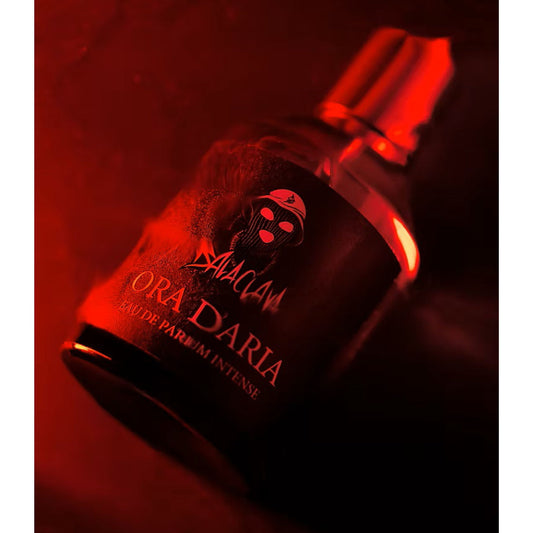
ORA D'ARIA
Vendor:BalaclavaRegular price €165,00Regular priceUnit price for -
DESERT OUD
Vendor:Habibi New YorkRegular price €150,00Regular priceUnit price for -
DESIRTOXIC
Vendor:M. MicallefRegular price €245,00Regular priceUnit price for -
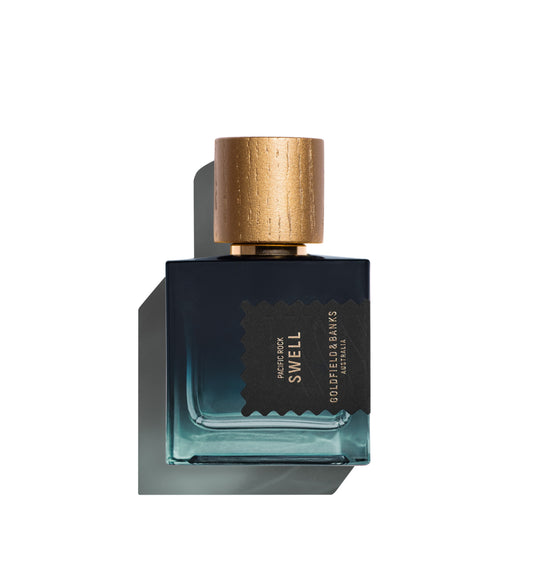
PACIFIC ROCK SWELL
Vendor:Goldfield & BanksRegular price From €175,00Regular priceUnit price for -
GREEN FOREST
Vendor:Al AmbraRegular price €80,00Regular priceUnit price for







A guide to woody perfumes
What is a woody perfume?
In perfumery, “woody” means a family built on woods and roots. Its classic materials are cedarwood, sandalwood, vetiver and patchouli, together with oud, guaiac wood and oakmoss. Woods are base notes: they provide the structure, the “backbone” on which the other notes rest, and it is rare to find a perfume that contains none.
Not all woody perfumes are alike. Cedarwood is dry and recalls pencil shavings, sandalwood is creamy and soft, vetiver earthy and smoky, patchouli dark and camphorous, oud resinous and intense. And two of the family's best-loved materials are not even woods: vetiver is a root, patchouli a leaf.
Woody, woody amber or aromatic?
Three closely related terms that mean different things.
Woody
The heart of this family
- What it isPerfumes built on woods and roots such as cedarwood, sandalwood, vetiver and patchouli
- ScentDry or creamy, earthy, sometimes smoky
- In the wheelThe Woody family, with the subfamilies Woods, Mossy Woods and Dry Woods
Woody amber
An amber with woods
- What it isAn amber base of resins and vanilla enriched with woods such as sandalwood and patchouli
- ScentWarm, soft, enveloping
- In the wheelThe Woody Amber of the Amber family; until 2021 it was called Woody Oriental
Aromatic
The freshest neighbour
- What it isPerfumes built on lavender and aromatic herbs such as thyme, rosemary and sage
- ScentFresh, herbaceous, clean
- In the wheelThe Aromatic (fougère) of the Fresh family, right after the woods
Classification systems differ too. For the Société Française des Parfumeurs, woody amber (“boisé ambré”) is one of the nine subfamilies of the Boisés, the woody perfumes, which have been a family of the official French classification since 1990.
A story as old as the temples
Fragrant woods are among the oldest materials in history. Cedar was prized in antiquity for building great sacred structures and is mentioned 103 times in the Bible; the Forest of the Cedars of God, in Lebanon, has been a UNESCO World Heritage Site since 1998. In Egypt, in an embalming workshop at Saqqara from about 2,500 years ago, cedar oil is the second most frequently found product in the vessels, as shown by a study published in Nature in 2023.
In India sandalwood appears in the Vedic texts, in the Mahabharata and in the texts of Ayurveda, and it was used by temple and court perfumers. In 1792 the Kingdom of Mysore made it a state monopoly, which lasted until 2001.
Modern perfumery has made woods a family of their own. The main milestones:
- 1926Bois des Îles by Chanel, created by Ernest Beaux: sandalwood and vetiver with tonka bean, vanilla and aldehydes.
- 1959Vétiver by Guerlain, the first creation of Jean-Paul Guerlain.
- 1973IFF patents Iso E Super, the molecule of velvety wood.
- 1988Fahrenheit by Dior uses Iso E Super in a very high dose, about a quarter of the formula.
- 1990Égoïste by Chanel, created by Jacques Polge, is born from Bois des Îles.
- 1990The Société Française des Parfumeurs adds the “Boisés” to its official classification.
- 1992Féminité du Bois by Shiseido, conceived by Serge Lutens with Pierre Bourdon and Christopher Sheldrake, brings cedarwood into feminine perfumery.
- 1998The Forest of the Cedars of God, in Lebanon, becomes a UNESCO World Heritage Site.
- 2006Terre d'Hermès by Jean-Claude Ellena, a “mineral and woody” perfume.
- 2006Molecule 01 by Escentric Molecules, made of a single molecule: Iso E Super.
- 2011Santal 33 by Le Labo, created by Frank Voelkl, built on Australian sandalwood.
- 2021In Michael Edwards' Fragrance Wheel “Woody Oriental” becomes “Woody Amber”.
Today niche perfumery takes woods in every direction: pure, spicy, leathery, smoky, gourmand.
The raw materials of woody perfumes
Cedarwood
Cedrus atlantica · Morocco
Atlas cedar grows in the mountains of Morocco between 1,300 and 2,600 metres and can live up to 2,000 years. The oil is distilled from sawdust, a by-product of woodworking, and smells of warm, dry, resinous wood. So-called Virginia cedar is actually a juniper, Juniperus virginiana: its scent is linked to the pencils of the 19th century.
Sandalwood
Santalum album · India and Australia
Only the heartwood, the core of the wood, is fragrant: the outer part is odourless. Sandalwood is a hemiparasite, taking water and nutrients from the roots of a nearby plant. Indian sandalwood is now listed as Vulnerable by the IUCN, so many perfumers use Australian sandalwood, Santalum spicatum, which is earthier and smokier.
Vetiver
Chrysopogon zizanioides · Haiti
It is not a wood but a grass: perfumery uses the root, which reaches down as far as two metres. Haiti produces more than half of the world's vetiver and the centre of its trade is Les Cayes. The plant grows for twelve months before harvest; the roots are washed, dried in the shade and steam-distilled.
Patchouli
Pogostemon cablin · Indonesia
It belongs to the same family as mint and lavender: the leaves are dried in the sun, fermenting slightly, and then distilled. Indonesia supplies more than 80% of the world's patchouli, mainly from the island of Sulawesi, and the farmers themselves often distil it on a small scale. It is the most frequent note in our woody perfumes.
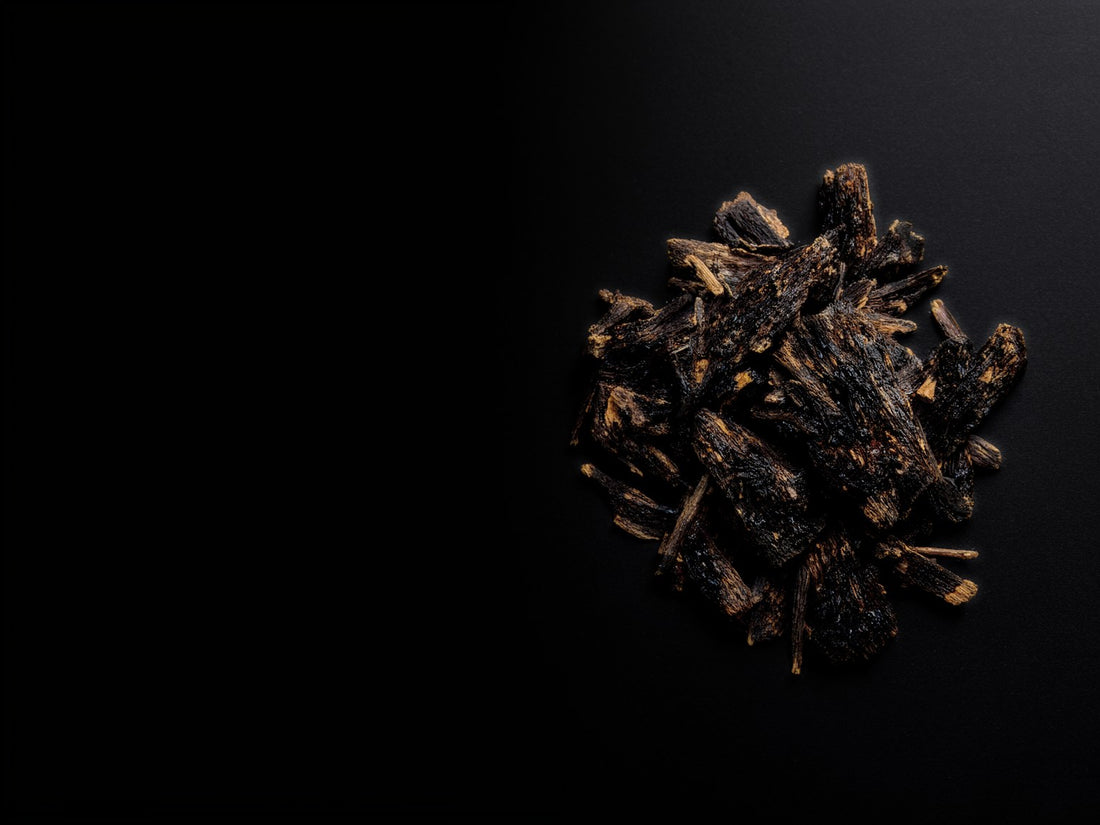
Oud
Aquilaria · Southeast Asia
Agarwood becomes oud only when the tree, wounded and infected by a fungus, produces a dark resin to defend itself. The whole genus Aquilaria has been protected by the CITES convention since 2004. In woody perfumes it brings a dark, resinous and smoky depth.
Guaiac wood
Bulnesia sarmientoi · Paraguay
It grows only in the Gran Chaco, between Argentina, Bolivia, Brazil and Paraguay, and is one of the hardest and heaviest woods. The oil, distilled from shavings and sawdust, comes from Paraguay; since 2010 its trade has been regulated by CITES. In perfumery it warms compositions and helps build sandalwood and vanilla notes.
Oakmoss
Evernia prunastri · Balkans and Morocco
Despite its name it is a lichen, picked by hand from oak branches and dried before extraction. It is the soul of chypre accords and gives woody perfumes a warm, mossy base. Two of its natural components, atranol and chloroatranol, have been banned in cosmetics in Europe since 2019: today purified grades with a low atranol content are used.
Woody molecules
Iso E Super, Cashmeran, Ambrox
Part of modern woody perfumery is born in the laboratory. Iso E Super, patented by IFF in 1973, is woody, soft and velvety; Molecule 01 by Escentric Molecules, since 2006, is made of this molecule alone. Cashmeran, also patented by IFF in 1973, adds a powdery, velvety effect. Ambrox, synthesised by Firmenich in 1950 from clary sage, brings an ambery warmth with woody nuances.
The nuances of woody perfumes
In Michael Edwards' Fragrance Wheel the woody family includes three subfamilies, Woods, Mossy Woods and Dry Woods, and borders the ambers on one side and the aromatics on the other. From the amber side to the aromatic side:
← AmbersAromatics →
Woody amber
Woody Amber
On the border with ambers: a warm base of resins and vanilla enriched with sandalwood and patchouli.
Woody
Woods
The heart of the family: clean, refined woods such as cedarwood and vetiver.
Mossy woody
Mossy Woods
Woods meet oakmoss: this is the name Edwards gives to chypres.
Dry woody
Dry Woods
Woods dried out by smoky and leathery notes.
In everyday language people also speak of spicy, floral, aromatic, fruity and gourmand woody perfumes. You will find them all in our collection: to see them, use “Find your woody” at the top of the page or the fragrance family filter.
When to wear a woody perfume
Woody perfumes are at their best in autumn and winter, in the evening and on special occasions. The lighter versions, with citrus, green notes or a luminous sandalwood, are easy to wear all year round, even in summer; the more intense oud and vetiver prefer the cold.
Woods are base notes: this is why woody perfumes last a long time and leave a trail. Sandalwood, patchouli and oud are among the most tenacious materials.
Frequently asked questions
What does “woody” mean in perfumery?
A woody perfume is built on woods and roots such as cedarwood, sandalwood, vetiver and patchouli, which give it a warm or dry, creamy or earthy character. Woods are base notes and provide the structure for the whole composition.
Are woody perfumes for men?
For a long time the family was associated with men's perfumery, but today woody perfumes are worn by everyone. In 1992 Féminité du Bois brought cedarwood into feminine perfumery, and niche perfumery no longer separates masculine and feminine: sandalwood and cedarwood are also at home in unisex perfumes. The best way to choose is to try them on your skin.
Are vetiver and patchouli woods?
No: vetiver is the root of a grass, patchouli the leaf of a plant of the mint family. In perfumery, however, they are among the pillars of the woody family, thanks to their earthy, deep character.
What is the difference between woody and woody amber?
A woody perfume is built on woods; a woody amber starts from an amber base of resins and vanilla and enriches it with woods such as sandalwood and patchouli. In Michael Edwards' Fragrance Wheel the first is a family, the second a subfamily of the ambers: until 2021 it was called “Woody Oriental”. You will find both in our collection.
Can I try a woody perfume before buying it?
Yes. With every order over €100 you receive 10 free samples, and you choose 5 of them yourself: it is the easiest way to discover a woody perfume on your skin before buying the bottle. If you are near Rome, you can try them in person at our boutique in Nettuno.
Are woody perfumes long-lasting?
Yes, they are among the longest-lasting: woods are base notes that evaporate slowly, so a little is enough. Sandalwood, patchouli and oud are among the most tenacious materials.
Found your woody?
Choose from the 214 woody perfumes in our boutique, signed by the finest international niche houses.
- 10 free samples with every order over €100, you choose 5 of them
- Free shipping in Italy on orders over €60
- Boutique in Nettuno, near Rome, to try them in person